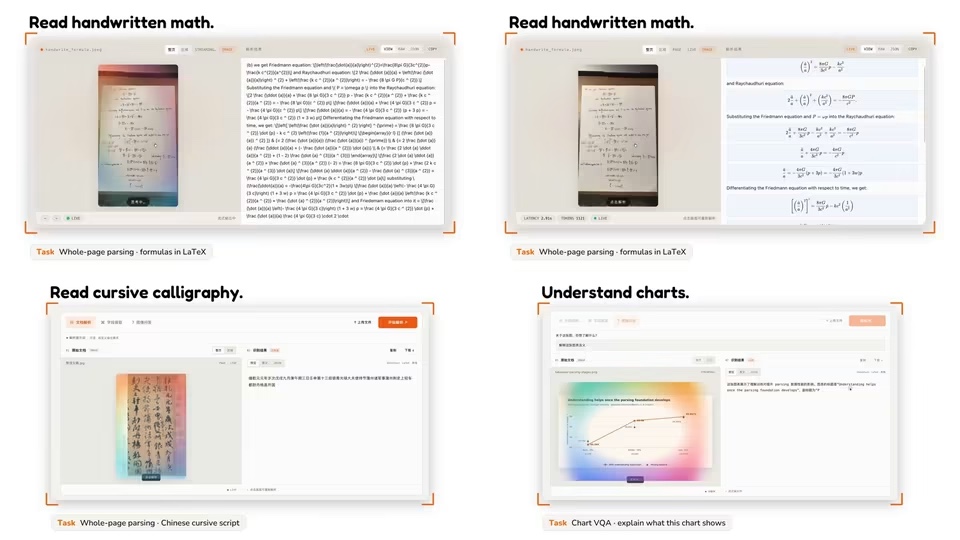
Xiaomi OCR 0.8B is an open-source optical character recognition model that promises to run entirely on-premise, enabling developers to embed it in pipelines for invoices, contracts, PDF scans and other document types without ever transmitting customer data to a third-party cloud.
Xiaomi OCR 0.8B Overview
The model, named Xiaomi-OCR-0, builds on the Qwen3.5-0.8B foundation and was trained with roughly 170 million OCR samples. It is released under the Apache 2.0 license, and the community has already packaged it in GGUF format, yielding an Ollama-compatible binary of about 1.8 GB. Alongside the weights, Xiaomi shipped a full inference codebase, a demo, an MCP service, and an Agent Skill bundle, so users receive a complete toolkit rather than a bare model.
Benchmark Performance
Official numbers place the model at 95.24 on Real5-OmniDocBench (rank 1), 96.83 on OmniDocBench v1.6 (rank 2), and 87.94 on Wild-OmniDocBench. It scores 97.84 on mathematical formula recognition, 92.27 on table detection, and an average of 83.2 across five VQA benchmarks-outperforming the larger Qwen3.5-2B (80.9) despite having nearly three-times fewer parameters. These results sound impressive, but benchmark scores do not guarantee success on messy Vietnamese invoices, blurred receipts, or skewed contract scans.
Practical Deployment Benefits
Because the binary is only about 1.8 GB, the model can be deployed on modest hardware that typically sits under a desk. This contrasts with the industry trend of chasing 400 B-parameter giants for tasks that merely require "read this image and output JSON." For many real-world use cases, a 0.8 B model is sufficient and far more cost-effective.
Known Limitations and Community Feedback
Early comments on Xiaomi's X post highlighted concrete shortcomings: the model struggles with strikethrough characters, misclassifies certain paper types, and often needs clarification when handling tables. In other words, a high benchmark ranking does not automatically translate to flawless performance on Vietnamese documents, low-quality scans, or angled PDFs. To gauge true reliability, developers should feed the model their 20 most challenging images from their own repositories and scrutinize the results.
Conclusion
While Xiaomi OCR 0.8B delivers an appealing mix of open-source licensing, lightweight deployment, and strong benchmark numbers, teams must validate it against their own edge cases before replacing existing OCR solutions. What OCR engine are you currently using, and will you consider swapping to this 0.8 B model, or will you stay with larger models out of concern for silent errors?