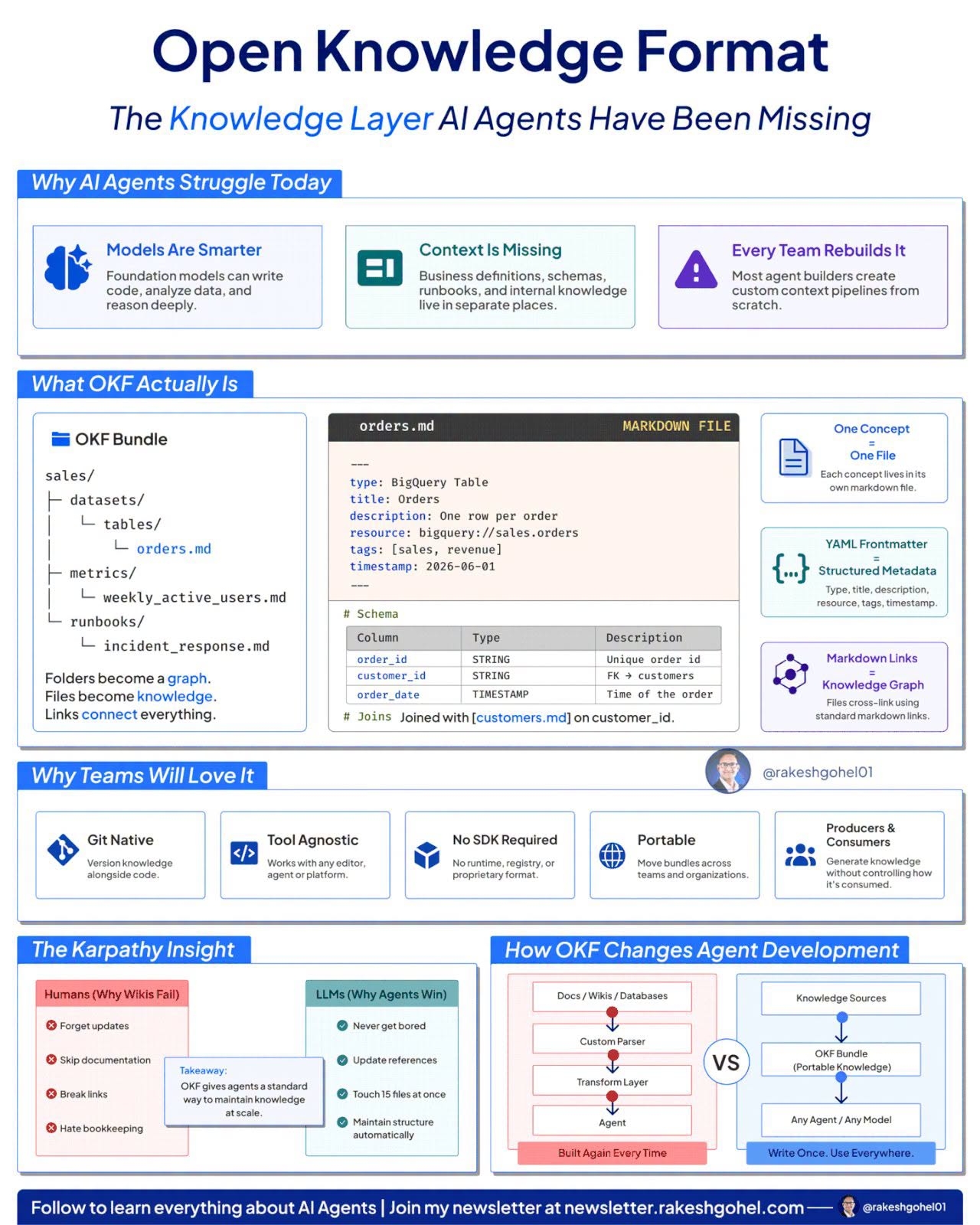
The concept of Open Knowledge Format has finally provided a standardized solution for the long-standing issue of context in artificial intelligence. As Andrej Karpathy pointed out, the main bottleneck in AI development is not the model itself, but rather the lack of context. This is precisely the problem that Open Knowledge Format aims to solve.
Introduction to Open Knowledge Format
Open Knowledge Format is an open standard that enables the structuring of knowledge in a way that allows AI agents to produce accurate and useful results. Unlike traditional methods, where each developer had to manually create context from scratch, Open Knowledge Format provides a standardized format for representing knowledge.
What is Open Knowledge Format?
In essence, Open Knowledge Format is a simple directory containing markdown files. Each concept is represented by a single file, which can include tables, indicators, runbooks, or APIs. The YAML front matter contains structured fields such as type, title, description, resource, tags, and timestamp. These files are interconnected through standard markdown links, forming a graph-like structure. The key benefits of Open Knowledge Format include:
- No SDK required
- No central registry needed
- No new runtime environment necessary
- Any text editor can read the files
- Any agent can consume the knowledge
How Open Knowledge Format Changes the Game
The introduction of Open Knowledge Format revolutionizes the development of AI agents in several ways:
- Knowledge bundles can be stored in git repositories, version-controlled alongside the code they describe
- Any editor can read the files, and any agent can consume the knowledge
- Producers and consumers are completely independent of each other
- A wiki written by humans and a pipeline exported from BigQuery can both feed the same agent without requiring any conversion layers
- Knowledge bundles can be easily transferred between tools, teams, and organizations without rebuilding anything
Key Insights from Karpathy
Andrej Karpathy's insight into why wikis often fail is that humans get bored and abandon the task of updating them. In contrast, Large Language Models (LLMs) do not get bored and can update cross-references without forgetting. LLMs can also edit multiple files in a single run. Open Knowledge Format provides a standardized format for agents to perform these tasks on any team, tool, or model. This is how we can stop rebuilding context pipelines from scratch every time a new model is introduced.
Key Components to Understand
Most modern AI systems combine several layers: data sources, model architecture, training infrastructure, evaluation methods, and deployment controls. Each layer affects accuracy, latency, cost, and reliability in production.
Readers should also understand the role of prompts, context windows, retrieval systems, monitoring, and human review. These components often decide whether a system is merely impressive in a demo or dependable enough for real workflows.
Limitations and Risks
No technical concept should be presented as magic. The article should explain where the approach can fail, including inaccurate outputs, outdated context, biased data, privacy concerns, unclear evaluation, and operational cost.
These limitations do not make the technology unusable, but they do shape how teams should apply it. Good implementation usually includes validation, logging, security review, and a plan for human oversight when decisions matter.
Practical Takeaways
- Start with the core concept before moving into architecture or implementation.
- Connect each technical detail to a practical use case or decision.
- Call out limitations clearly so readers know how to apply the idea responsibly.
Implementation Considerations
When teams apply Open Knowledge Format Solutions, they need more than a conceptual overview. They should decide what data is allowed, how outputs will be reviewed, what performance metrics matter, and where the technology fits inside an existing workflow.
A practical implementation also needs clear ownership. Product teams define the user problem, engineers manage reliability and integration, security teams review data exposure, and business stakeholders decide what level of automation is acceptable.
How to Use This Resource Effectively
A useful article about Open Knowledge Format Solutions should help readers connect the simple explanation, the technical mechanism, and the practical decision they may need to make next. That means the content should not stop at definitions; it should show why the topic matters, where it fits, and how readers can evaluate it responsibly.
For beginners, the most important value is a clear mental model. They should understand the problem the technology solves, the kind of input it receives, the kind of output it produces, and the reason results can vary from one situation to another.
For technical readers, the article should point toward architecture, data quality, evaluation, and deployment tradeoffs. These details explain why two systems with similar demos can behave very differently in production, especially when the data is specialized or the workflow has strict quality requirements.
For business readers, the practical question is not whether the technology is impressive. The better question is whether it can reduce friction, improve decision quality, support a team process, or create a better user experience without adding unacceptable operational risk.
The strongest next step is to compare a short accessible resource with a deeper technical resource, then write down what each one clarifies. That approach gives readers both confidence and caution, which is usually the right balance for fast-moving technology topics.
Readers should also look for examples that show both successful and difficult cases. A balanced example set makes the article more useful because it reveals the boundary between a clean demonstration and a real operating environment.
Finally, every recommendation should connect back to a practical decision. If the article cannot help someone choose what to learn, test, adopt, avoid, or monitor next, it probably needs more context before publication.
Readers should use the linked source to compare the summary against the original implementation details, especially when architecture, tooling, or deployment steps influence the final decision.
- Define the core concept in plain language.
- Identify the main technical components.
- Map the idea to real workflows.
- Check limitations before recommending adoption.
- Use references to verify important claims.
Source Images
Conclusion
In conclusion, Open Knowledge Format is a game-changer for AI development, providing a standardized knowledge format for agents. By adopting Open Knowledge Format, developers can create more efficient and scalable AI systems. The Open Knowledge Format solutions offer a simple yet powerful way to structure knowledge, enabling AI agents to produce accurate and useful results.