NVIDIA has once again pushed the boundaries of AI efficiency with a significant breakthrough: a method to enable NVIDIA KV Cache Conversion between different large language models (LLMs). This innovation allows a target model to completely bypass the prefill step, with the conversion process running 2.7 to 25 times faster than re-processing the entire context from scratch. Let's delve into why this development is so crucial right now.
The Challenge of Stateless LLMs and KV Cache Limitations
Understanding the importance of this breakthrough requires a look at the current state of LLM operations. LLM APIs are inherently stateless, meaning that for every turn in a conversation, the entire chat history must be sent back to the model. The model then has to re-read everything before generating even a single new token, and this entire re-read portion is charged as input. This significantly increases both latency and operational costs.
Prompt caching offers a partial solution, allowing LLM providers to store the KV cache of a stable prefix and charge for the matched portion at roughly 10% of the base input price, as the computation has already been performed once. However, this cache only works with the exact model that generated it. The Key and Value embeddings are derived from that specific model's weights, making them unreadable by any other model.
This limitation becomes particularly evident in LLM routing scenarios. If traffic is shifted to a different model due to cost or capacity reasons, the entire accumulated KV cache becomes worthless. Consequently, the accumulated context must be re-processed from the beginning at full cost, negating any efficiency gains from routing.
NVIDIA's Representation Problem Approach
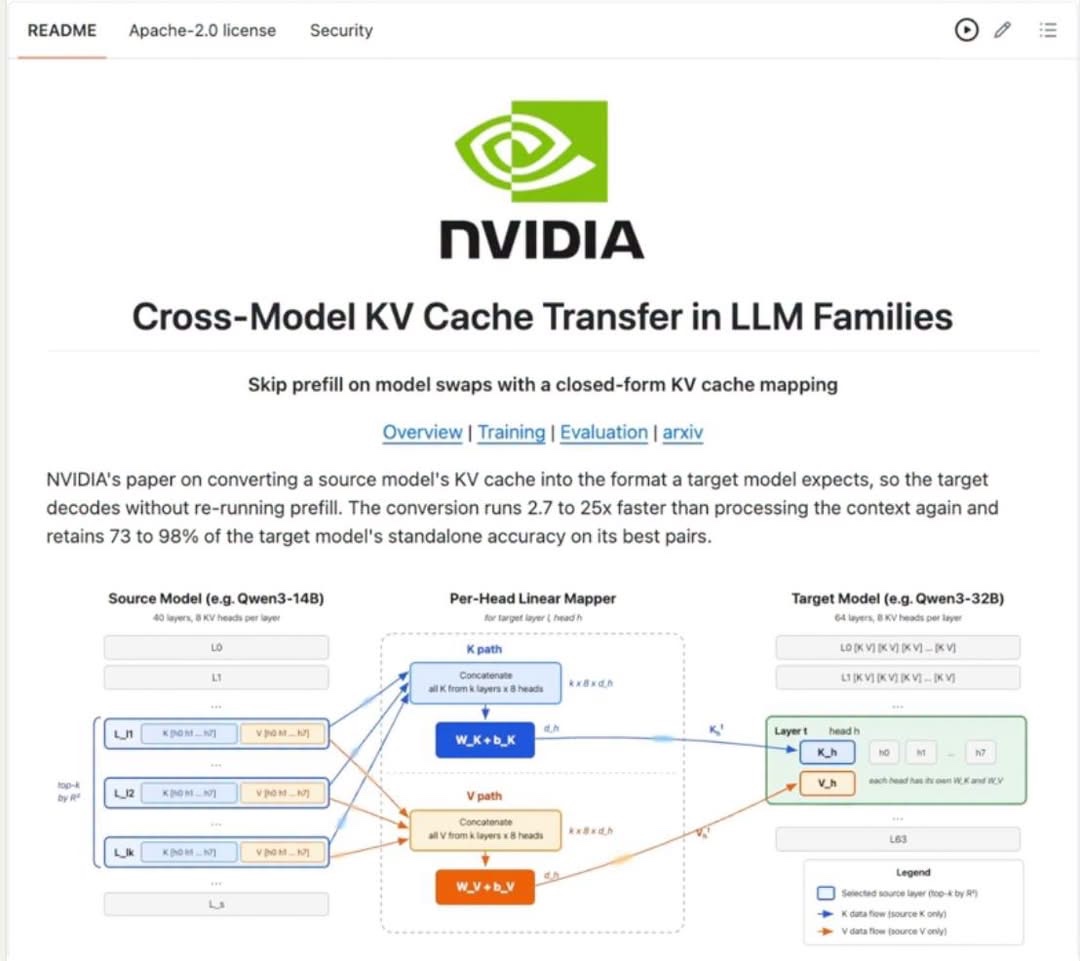
NVIDIA's recent paper tackles this fundamental issue by approaching it as a representation problem. The sole output of the prefill step is the KV cache. Therefore, to transfer KV cache between models, it needs to be converted into a format that the receiving model can understand.
Their research first examined whether this conversion was structural. Results showed that when converting from Qwen3 14B to 32B, a simple linear regression from a single source layer could reproduce 56% of the variance in the target model's Keys. Recognizing that two models can clearly have different numbers of layers, meaning no natural one-to-one pairing exists, they refined their approach. For each target layer, they ranked all source layers by how well they predicted that target layer, then simultaneously fed in the 8 best layers—boosting the reconstruction accuracy to 79%.
The proposed mapper consists of three key components:
1. Independent Linear Maps: Each layer and each head in the target model has its own independent linear map. 2. Cross-Layer Selection: The mechanism described above, selecting the best source layers for each target layer. 3. RoPE Handling: Key values carry a position-dependent rotation from RoPE (Rotary Position Embeddings). NVIDIA's method removes this rotation, trains the mapping in a position-independent space, and then reapplies the target model's rotation during inference.
Performance and Future Outlook
Across six model pairs from Qwen3, Llama 3.1, and Mistral 3, four pairs retained between 73% and 98% of the receiving model's original accuracy. Crucially, the conversion process was 3 to 25 times faster than re-processing the entire context. This means the target model completely skips the prefill step, leading to significant performance and cost benefits.
Previous research on reusing KV cache between models often required training a separate neural network adapter for each model pair or demanded that the two models have identical architectures. NVIDIA's approach offers a more flexible and efficient solution.
It's important to note that all tested model pairs belonged to the same model family (e.g., Qwen to Qwen, or Llama to Llama). Furthermore, all six model pairs shared the same number of KV heads and head dimensions across different scales. Cases with mismatched head configurations have not yet been verified.
While there is still much work to be done, the problem this research solves is genuinely valuable for the future of efficient and cost-effective LLM deployment and routing.
Source Images
Conclusion
NVIDIA's innovative NVIDIA KV Cache Conversion method represents a significant leap forward in optimizing LLM performance and reducing operational costs. By enabling efficient context reuse across different models, it addresses a critical bottleneck in current LLM architectures, paving the way for more dynamic and economical AI applications.