
In the rapidly evolving landscape of artificial intelligence, a significant number of professionals currently dedicate almost their entire focus to Large Language Models (LLMs) and related applications, such as Retrieval-Augmented Generation (RAG) systems and chatbots. While these technologies are undeniably transformative, it's crucial for AI Engineers to broaden their perspective. The reality is that traditional Machine Learning models continue to play an extremely important role in deployed products and services. Bringing these models into production presents a unique set of challenges that differ significantly from those encountered in conventional software development. This is where a deep understanding of CI/CD for Machine Learning becomes not just beneficial, but absolutely essential for creating real business value.
The Broader Landscape of AI Engineering Beyond LLMs
While the allure of LLMs is strong, many critical business problems are still best solved, or even exclusively solvable, by traditional ML models. These models power everything from recommendation engines and fraud detection systems to predictive maintenance and medical diagnostics. The value they generate is immense, yet their journey from development to deployment is fraught with complexities that go far beyond model training or prompt engineering.
When we talk about putting ML models into production, we're not just talking about deploying a static piece of code. We're dealing with dynamic systems that involve data pipelines, model retraining, versioning, and continuous monitoring. These elements introduce challenges that are fundamentally different from deploying a web application or a backend service. For instance, data drift can silently degrade model performance, and changes in feature engineering can break downstream components. This necessitates a specialized approach to continuous integration and continuous delivery (CI/CD) that is tailored to the unique lifecycle of machine learning.
Understanding CI/CD for Machine Learning
Traditionally, in many development workflows, the CI/CD pipeline and the ML Training pipeline have been treated as two separate entities. A conventional CI/CD pipeline typically handles the testing, packaging, and deployment of software artifacts. On the other hand, an ML Training pipeline is responsible for data ingestion, model training, evaluation, and saving the trained model.
However, a critical insight for robust MLOps is this: an ML Training pipeline is, in fact, an artifact of the ML project itself. As such, it needs to be integrated into CI/CD processes just like any other piece of code. This integration ensures that the entire ML system, including its training mechanism, is reliable, reproducible, and continuously deliverable. Specialized tools like Kubeflow Pipelines and SageMaker Pipelines have emerged to facilitate this integration, providing frameworks to define, execute, and manage complex ML workflows as part of a larger CI/CD strategy.
Traditional CI/CD vs. MLOps CI/CD
To appreciate the nuances of CI/CD for Machine Learning, let's first revisit the three main steps of traditional CI/CD:
- Step 1: Unit Test: This involves checking individual functions and modules with fixed inputs to ensure they perform as expected.
- Step 2: Integration Test: This step verifies the ability to connect with databases, external services, and ensures proper communication between different modules within the application.
- Step 3: Delivery: This final stage involves deploying the software artifact to a staging or production environment, often following a GitFlow methodology.
While these principles form the foundation, the unique characteristics of ML models and their dependencies require a significant expansion of these steps.
Extending CI/CD for ML Training Pipelines
When an ML Training pipeline is introduced, the scope of CI/CD expands considerably to accommodate the data, model, and infrastructure complexities. Here's how the traditional steps are adapted and extended for MLOps:
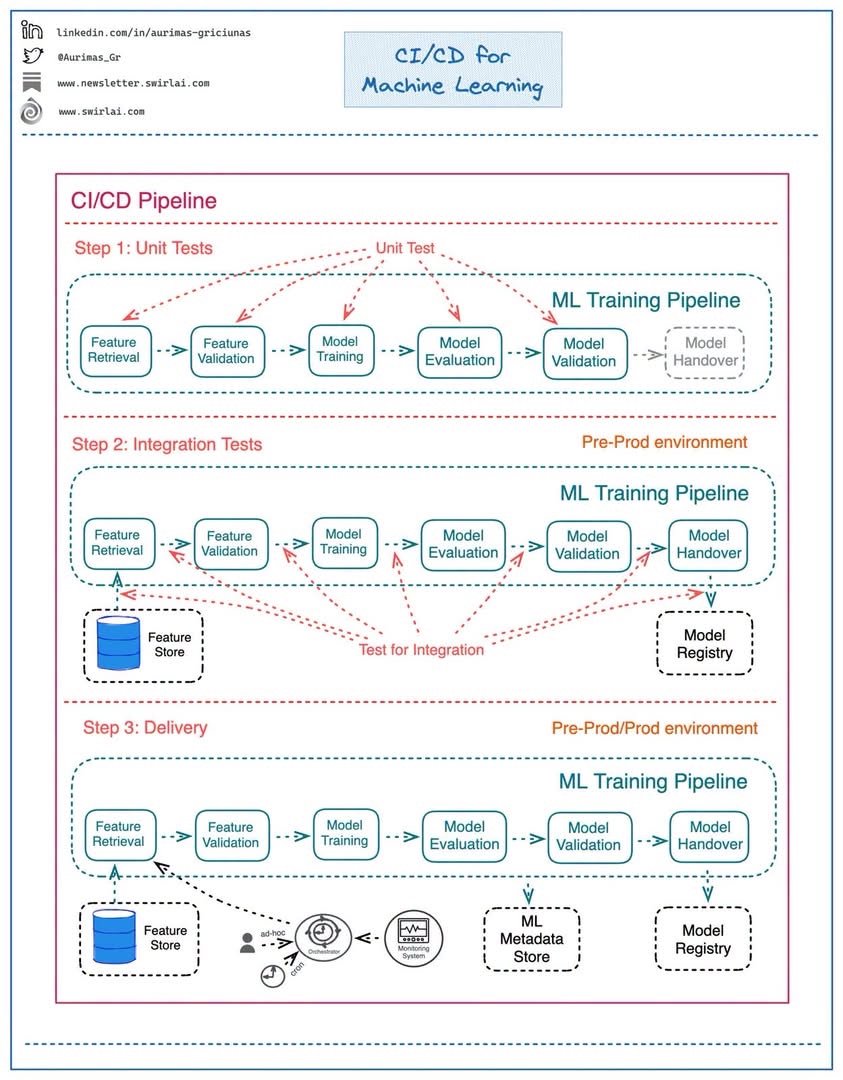
Unit Testing in ML Pipelines
In a well-structured MLOps setup, each step of the training pipeline is treated as pure code. This means that individual components—such as data preprocessing functions, feature engineering modules, model architecture definitions, or evaluation metrics—can be unit tested independently, just like any other software module. This ensures that each piece of the ML pipeline functions correctly in isolation before being integrated into the larger workflow. For example, a data transformation function can be tested with sample data to ensure it produces the expected output, or a 风俗 loss function can be verified for mathematical correctness.
Integration Testing for ML Pipelines
Integration testing in an ML context goes beyond traditional software checks. It focuses on the seamless interaction between various ML-specific components and external services. Key checks include:
- Data Source Connectivity: Does the pipeline successfully retrieve data from the Feature Store? This is crucial for ensuring that the model always trains on the correct and most up-to-date features.
- Model Registry Interaction: Can the trained model be successfully saved to the Model Registry? This ensures proper versioning, traceability, and discoverability of models for deployment.
- Metadata Logging: Does the pipeline correctly log metadata into the ML Metadata Store? This includes parameters, metrics, data versions, and artifacts, which are vital for reproducibility, debugging, and auditing.
- 国际米兰-Step Data Transfer: Crucially, do the steps in the pipeline correctly transfer data to each other, for example, from the training phase to the evaluation phase? This ensures that the evaluation is performed on the data processed and used by the training step, preventing data leakage or misalignment issues.
These integration tests are vital for catching issues related to data schema changes, API version mismatches, or incorrect configuration of ML services before they impact production models.
Delivery and Deployment of ML Pipelines
In the context of MLOps, the delivery step involves deploying the entire training pipeline, not just the trained model itself, to pre-production or production environments. This means that the code defining the data ingestion, feature engineering, model training, and evaluation logic is deployed and orchestrated. This approach ensures that the entire process for generating and updating models is automated and reliable. When a new version of the training pipeline is deployed, it can automatically retrain models with fresh data, evaluate their performance, and, if metrics meet predefined thresholds, promote the new model to serve predictions. This continuous retraining and deployment capability is a hallmark of mature MLOps practices.
Source Images
Conclusion
For AI Engineers, the role extends far beyond merely training models or prompting LLMs. While these skills are valuable, true impact comes from understanding the entire lifecycle of an ML product. In many scenarios and for numerous problems, knowing how to properly put Machine Learning into production through robust CI/CD for Machine Learning practices is what generates real, tangible value for businesses. By embracing MLOps principles and integrating ML training pipelines into CI/CD, AI Engineers can build reliable, scalable, and maintainable AI systems that continuously deliver value and adapt to changing data landscapes. This holistic approach is the future of practical AI engineering.