For a long time, AI memory has been treated as an external component. The model itself would remain static, surrounded by external storage, rigid rules dictating what to remember, and often even a second model dedicated solely to managing that storage. This traditional approach often led to a fragmented memory system.
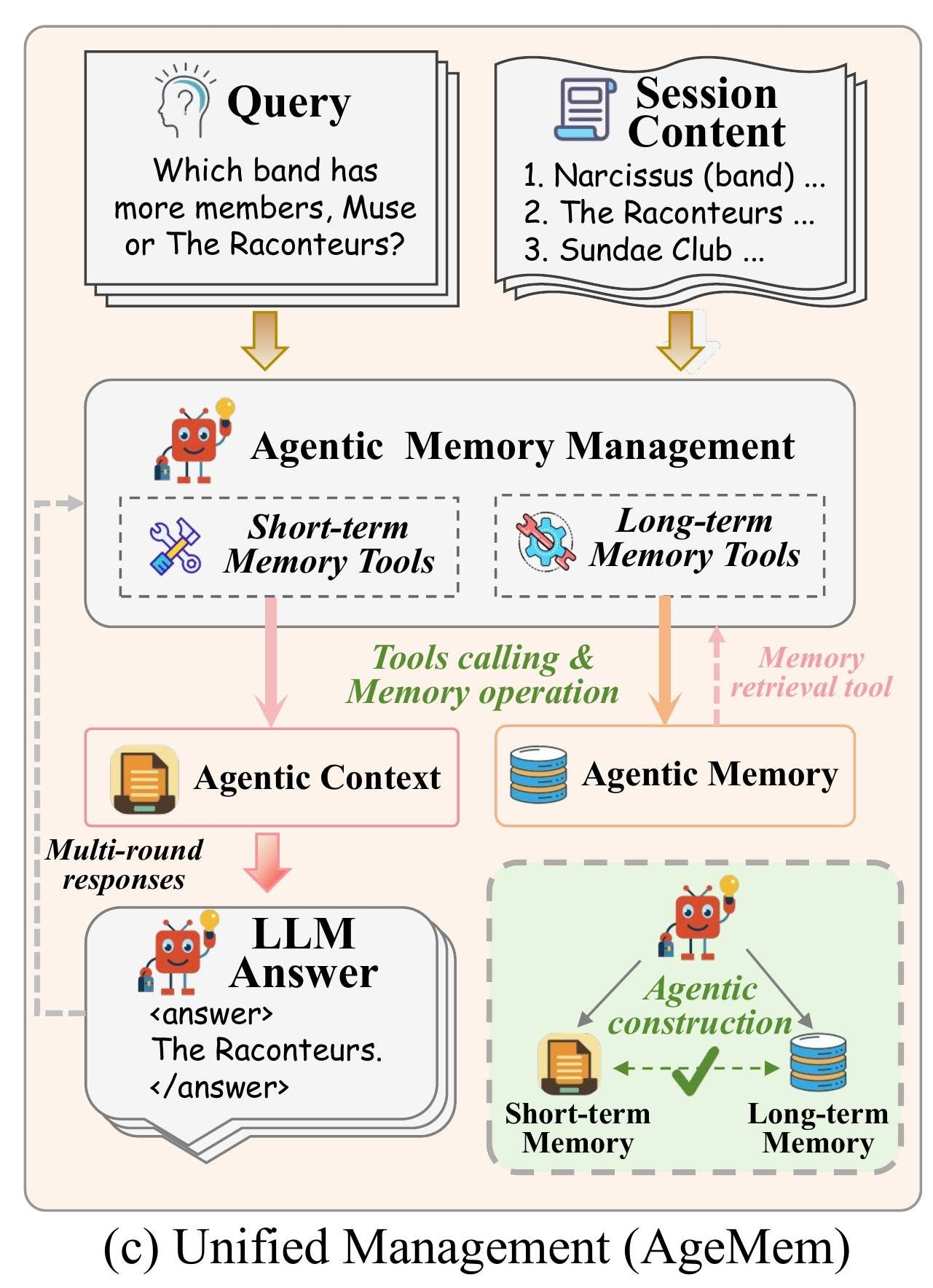
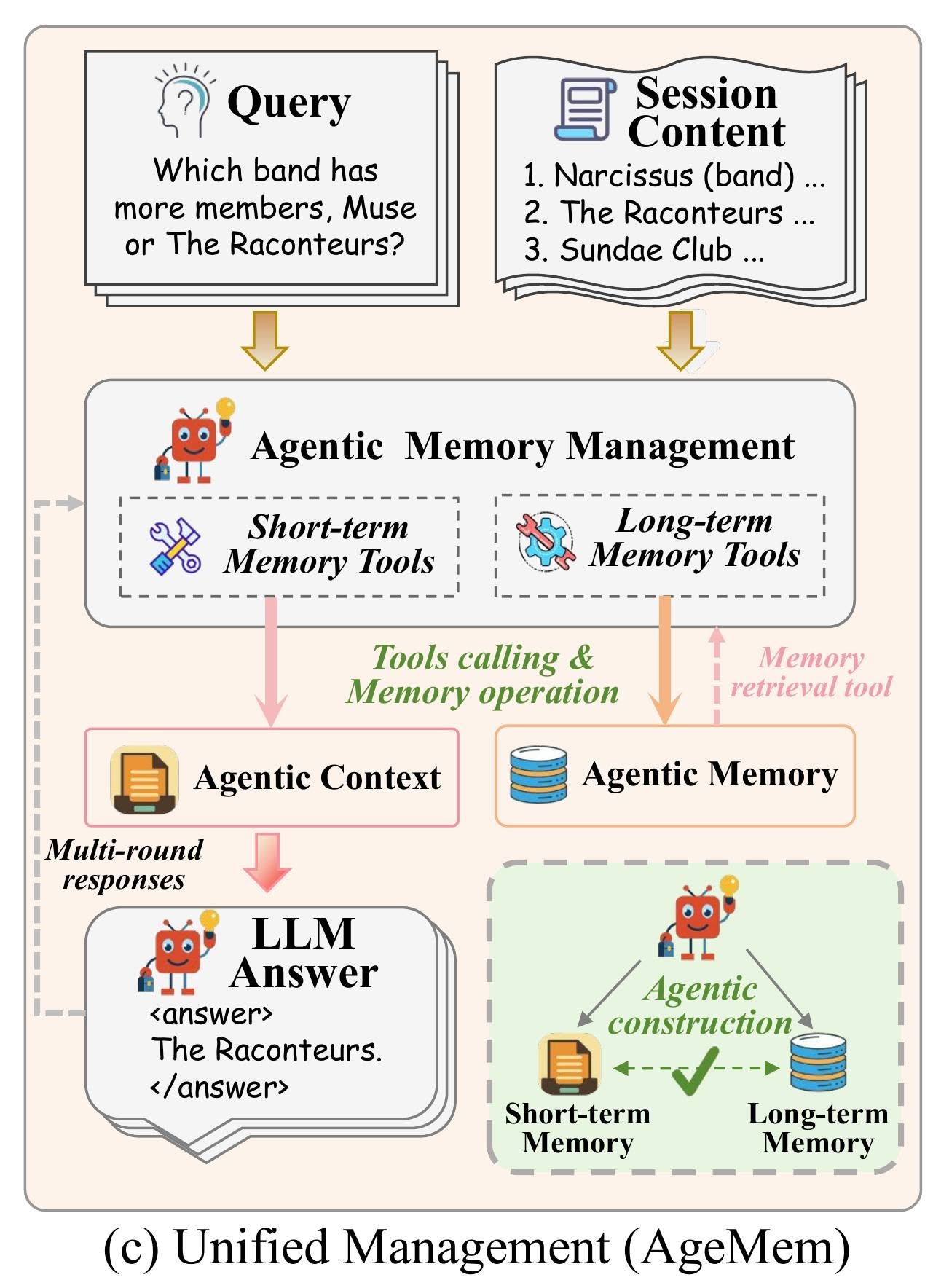
A groundbreaking paper, arXiv 2601.01885, submitted on January 5, 2026, by Wuhan University and Alibaba, overturns this arrangement. It proposes that memory is no longer an infrastructure built around the agent; instead, remembering becomes the agent's primary function. This new paradigm is central to AgeMem AI memory.
AgeMem's Integrated Memory Architecture
An agent's memory, particularly for an AI model that acts autonomously through multiple steps, is typically divided into two halves: long-term memory, which retains knowledge across multiple sessions, and short-term memory, which resides within the context window—what the model can immediately read, and this window always has limitations. The paper highlights that these two halves have historically been optimized separately and then haphazardly patched together, with no learning signals able to run across both.
AgeMem completely eliminates the external management model, transforming all memory operations into tools that the agent calls itself. There are precisely six such tools:
- For long-term memory: `ADD` to append new information, `UPDATE` to modify outdated entries, and `DELETE` to remove obsolete data.
- For short-term memory: `RETRIEVE` to pull old memories into the current context, `SUMMARY` to compress overly long segments, and `FILTER` to remove distracting parts.
Training AgeMem: Overcoming Delayed Rewards with GRPO
The primary challenge lies in teaching the model to use these six tools correctly, as rewards are often significantly delayed. An agent might store a piece of information at an early step, but only many steps later will it know if that storage decision was correct. To address this, the researchers employed `step-wise GRPO` (Gradient Policy Optimization), which assigns scores at the final step and back-propagates them to all preceding memory decisions within the same run.
The training process is divided into three stages:
1. Conversation: The agent converses to autonomously select what is worth saving. 2. Distractor Introduction: The context is cleared, but the long-term memory is retained, and distracting sentences are introduced. 3. Forced Retrieval: Finally, the agent is asked direct questions to compel it to retrieve the correct, previously stored information.
Performance and Behavioral Insights
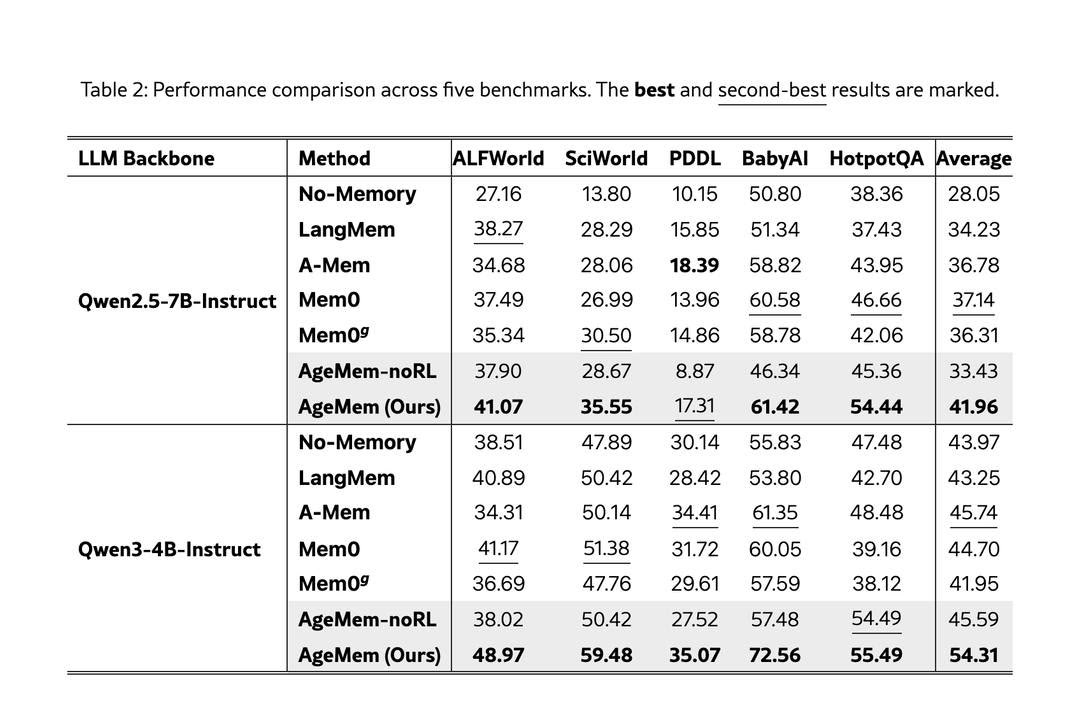
AgeMem demonstrated significant performance gains. On five benchmarks with the Qwen2.5-7B base model, AgeMem achieved an average score of 41.96, surpassing the previous best (Mem0 at 37.14) by 4.82 points. With Qwen3-4B, AgeMem reached 54.31 compared to A-Mem's 45.74, widening the gap to 8.57 points. Notably, the Reinforcement Learning (RL) training alone contributed 8.53 and 8.72 points, a contribution larger than the margin over the strongest competitor.
Beyond raw scores, the behavioral changes post-training were particularly interesting. The average number of `ADD` calls per episode increased from 0.92 to 1.64, `UPDATE` from 0.00 to 0.13, `DELETE` from 0.00 to 0.08, and `FILTER` from 0.02 to 0.31. Before training, the agent almost never modified or deleted memories, merely accumulating them. Conversely, `RETRIEVE` calls decreased from 2.31 to 1.95, which the authors explain by suggesting the agent retrieves less because it stores more accurately from the outset. Memory quality on HotpotQA, evaluated by another model, reached 0.533 with Qwen2.5 and 0.605 with Qwen3-4B.
Acknowledging Limitations and Nuances
The paper also candidly presents its limitations:
- Tools vs. Training: On Qwen2.5, the AgeMem toolset without training only achieved 33.43, lower than Mem0's 37.14. This indicates that the tools themselves are not the sole advantage; the training is paramount. However, this was only true for Qwen2.5, as the untrained version with Qwen3-4B scored 45.59, closely trailing the leaders.
- Shared Components: In Table 7, when the authors allowed all competitors to use their short-term memory component and training methodology, AgeMem's advantage dropped from 6.64 to 1.99 points on average across three benchmarks (43.69 compared to A-Mem's extended version at 41.70). This suggests that a significant portion of the performance gap comes from elements that any system could potentially learn to adopt.
- Not a Universal Win: AgeMem did not achieve an absolute victory across all metrics. For instance, on the PDDL planning benchmark with Qwen2.5, A-Mem scored 18.39, still outperforming AgeMem's 17.31.
Regarding context cost, AgeMem used an average of 2,117 tokens compared to 2,186 for the RAG variant, a reduction of 3.1%. With Qwen3-4B, it was 2,191 compared to 2,310, a 5.1% reduction. These reductions are small and measured against the team's own ablation study, making them a secondary result rather than a primary selling point.
作者-Stated Constraints and Future Scope
The authors explicitly state three limitations:
1. The toolset is fixed at six operations. 2. The benchmarks are still controlled environments, not real-world deployments. 3. The training data is solely derived from HotpotQA.
This last point is a double-edged sword: the fact that four other benchmarks showed transferability without retraining suggests a genuine ability to generalize to other environments. However, the entire system has only been trained on one type of task. Furthermore, the paper measures memory within controlled experimental runs, not memory about a real user extending over multiple interactions.
References
These external sources were used to verify the article and provide deeper context.
- Source: L Facebookgithub.com/y1y5/AgeMemOpen original resource
- Source: L Facebookl – L FacebookOpen original resource
Source Images
Conclusion
AgeMem AI memory represents a significant step towards more autonomous and efficient AI agents by integrating memory management directly into the agent's core functions. While demonstrating impressive performance gains and novel behavioral shifts, the research also transparently highlights the critical role of training, the impact of shared components, and the current limitations regarding tool flexibility, real-world applicability, and training data diversity. The source code is publicly available at @@N8NLINK0@@, and the paper has been recognized as an ACL 2026 SAC Highlight.