On September 5, Global Times reported that Yuanshan Zhixing Technology, a Chinese company, unveiled the Xiaoyuan guide robot, presenting an innovative solution for the visually impaired. This advanced robotic companion is designed to enhance mobility and independence, addressing a significant gap in support services.
Advanced Navigation and Obstacle Avoidance
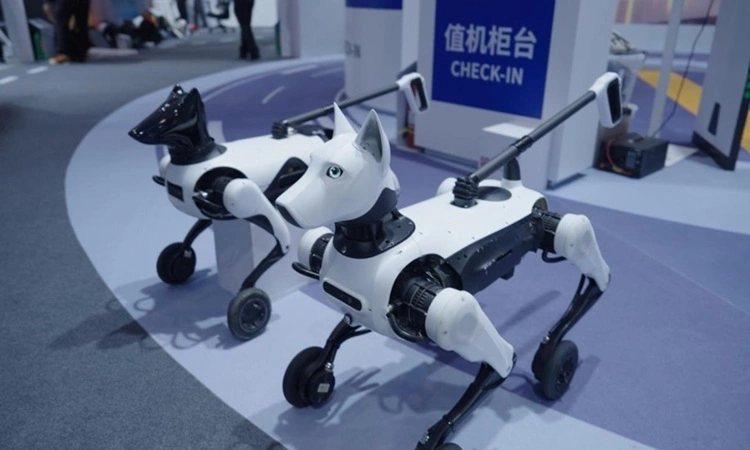
The Xiaoyuan guide robot features a unique mobility system, utilizing wheels integrated into its four legs for smooth movement on flat surfaces. When encountering stairs, it seamlessly transitions to using its legs for climbing and descending. This dual-mode locomotion allows the Xiaoyuan guide robot to navigate diverse environments effectively. Its obstacle avoidance capabilities are particularly impressive, achieving a success rate of at least 99% indoors and 96% outdoors, as reported by SCMP. Furthermore, its outdoor positioning error is controlled within 30 cm.
A key advantage of Xiaoyuan is its ability to detect overhead obstacles, such as low-hanging branches and scaffolding, which traditional white canes often miss. The robot is equipped with danger assessment capabilities, allowing it to automatically reduce speed or reroute to avoid hazards. Crucially, Xiaoyuan operates with low noise, ensuring it does not interfere with the user's ability to perceive their surroundings, a vital aspect of environmental awareness for the visually impaired.
Practical Design and Integrated Dịch vụ
Designed to resemble a traditional guide dog, Xiaoyuan is controlled via a leash, aligning with the familiar walking habits of its users. Beyond guidance, the robot offers multiple functions, including voice interaction, companionship, and reminders. It is also connected to a suite of services, including systems from federations for persons with disabilities, mapping services, and a remote support portal, enabling users to seek assistance from volunteers in emergencies.
Addressing a Critical Need
China faces a significant challenge with over 17 million visually impaired individuals but only approximately 400 trained guide dogs. The lengthy and intensive training process for guide dogs makes them inaccessible to many who need them. Robotic solutions like the Xiaoyuan guide robot offer a scalable alternative to help bridge this gap.
In a move towards practical implementation, the Chinese Association of Persons with Visual Disabilities (CAPVD) has partnered with disability organizations in Zhejiang and Inner Mongolia. They have initiated pilot programs for the Xiaoyuan guide robot in various locations, including subway systems and shopping malls in Hangzhou, the provincial capital.
Source Images
Conclusion
The Xiaoyuan guide robot represents a significant technological advancement in assistive devices, offering enhanced mobility and safety for the visually impaired. Its innovative design and robust performance metrics position it as a promising solution to a widespread societal need.