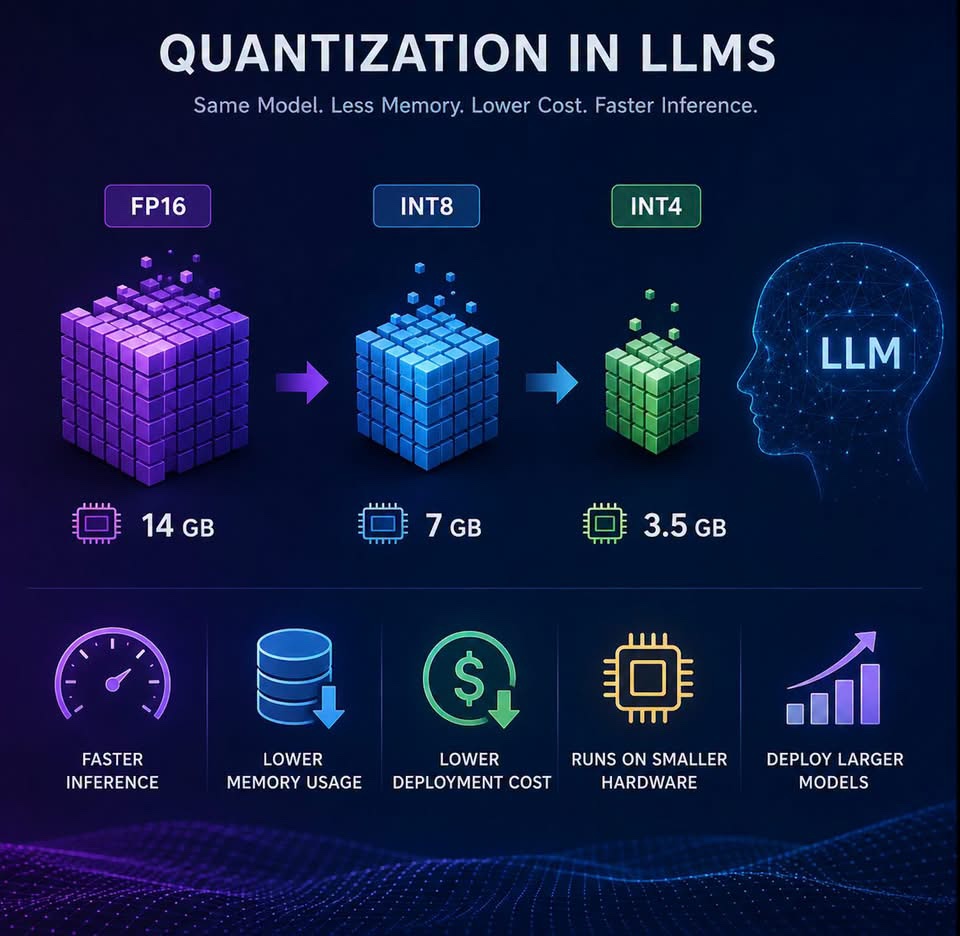
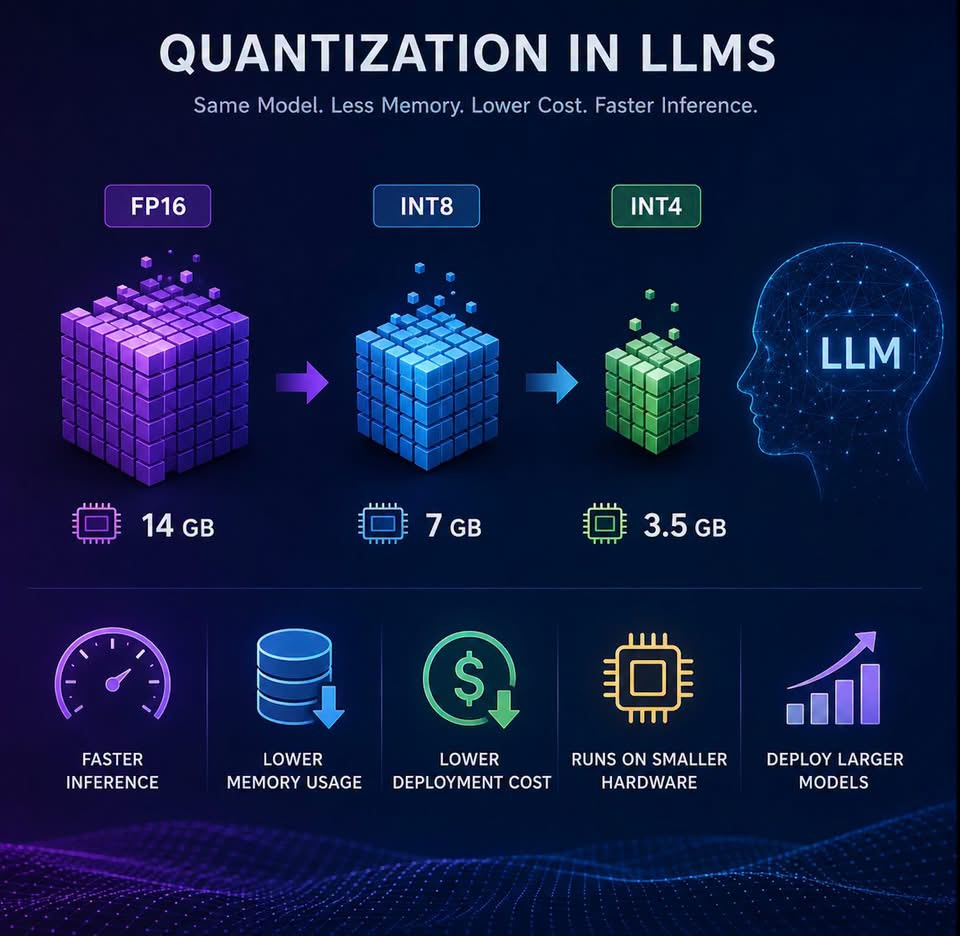
Quantization in LLM is a technique used to reduce the memory requirements of large language models. These models typically need a significant amount of memory to operate. For instance, a model with 7 billion parameters would require approximately 14 GB of memory using FP16, around 7 GB with INT8, and about 3.5 GB with INT4. Notably, the model's architecture remains unchanged; the system simply reduces the number of bits used to store the weights. Thanks to quantization, models can run faster, use less memory, reduce deployment costs, and even operate on smaller GPUs or personal computers. In exchange, the quality may slightly decrease in some cases. However, modern methods often help retain most of the model's performance. Essentially, quantization allows for the same model but makes it lighter, cheaper, and easier to deploy.
What is Quantization?
Quantization is a process that reduces the precision of the model's weights from a higher bit representation (like 32-bit floating-point numbers) to a lower bit representation (such as 8-bit or 4-bit integers). This reduction in precision leads to a decrease in the model's memory footprint and can also speed up computations, as operations on lower-bit representations are typically faster.
Benefits of Quantization in LLM
The benefits of quantization in large language models are multifaceted:
- Reduced Memory Usage: By decreasing the bit width of the model's weights, quantization significantly reduces the memory required to store the model. This is particularly beneficial for deploying models on edge devices or in environments where memory is limited.
- Improved Performance: Quantized models can run faster than their full-precision counterparts. This is because operations on lower-bit representations can be executed more quickly, especially on hardware optimized for integer operations.
- Lower Deployment Costs: With reduced memory and computational requirements, the cost of deploying and running large language models decreases. This makes it more feasible to integrate these models into a wide range of applications and devices.
- Broader Deployment Possibilities: Quantization enables the deployment of large language models on smaller GPUs, CPUs, or even specialized hardware like TPUs or edge devices, expanding the potential use cases for these models.
Considerations and Limitations
While quantization offers several advantages, it also comes with some considerations:
- Potential Quality Decrease: Reducing the precision of the model's weights can lead to a loss in model accuracy. However, the extent of this decrease can vary depending on the model, the quantization method used, and the specific task the model is being applied to.
- Quantization Methods: Different quantization methods can yield varying results in terms of model performance and efficiency. Some methods may better preserve the model's accuracy than others.
Practical Takeaways
For practitioners and developers looking to leverage quantization in their large language models, several key takeaways are worth considering:
- Evaluate Quantization Methods: Different quantization techniques can have significantly different outcomes. It's crucial to evaluate which method works best for your specific model and use case.
- Assess Model Sensitivity: Some models may be more sensitive to quantization than others. Understanding how quantization affects your model's performance is essential for making informed decisions.
- Consider the Deployment Environment: The choice of quantization method and the bit width should be influenced by the target deployment environment, including the available computational resources and memory constraints.
How Quantization in LLM Works
Quantization in LLM becomes clearer when readers can connect the high-level idea to the underlying workflow. A strong explanation should show the path from input data to useful output, including how information is represented, processed, and evaluated.
For technical readers, the most useful details are the steps that influence quality: data preparation, model architecture, training signals, inference behavior, and feedback loops. Explaining those steps gives the article more depth without forcing beginners into unnecessary jargon.
Key Components to Understand
Most modern AI systems combine several layers: data sources, model architecture, training infrastructure, evaluation methods, and deployment controls. Each layer affects accuracy, latency, cost, and reliability in production.
Readers should also understand the role of prompts, context windows, retrieval systems, monitoring, and human review. These components often decide whether a system is merely impressive in a demo or dependable enough for real workflows.
Implementation Considerations
When teams apply Quantization in LLM, they need more than a conceptual overview. They should decide what data is allowed, how outputs will be reviewed, what performance metrics matter, and where the technology fits inside an existing workflow.
A practical implementation also needs clear ownership. Product teams define the user problem, engineers manage reliability and integration, security teams review data exposure, and business stakeholders decide what level of automation is acceptable.
Source Images
Conclusion
Quantization in LLM is a powerful technique for reducing the memory footprint and improving the performance of large language models. By understanding the benefits, considerations, and practical implications of quantization, developers can make more effective use of these models in a wide range of applications, from edge devices to cloud services. Whether the goal is to deploy models on smaller hardware, reduce costs, or simply to make these powerful tools more accessible, quantization is an essential strategy to consider.