
Introduction to AI Agent Memory
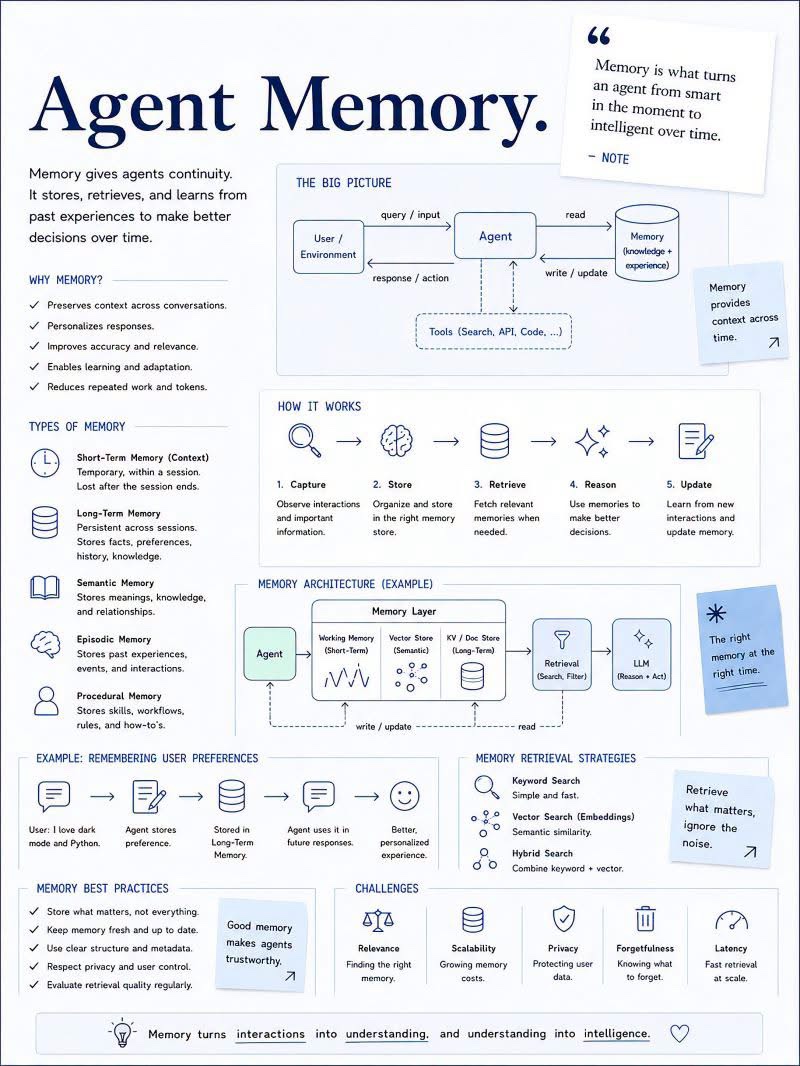
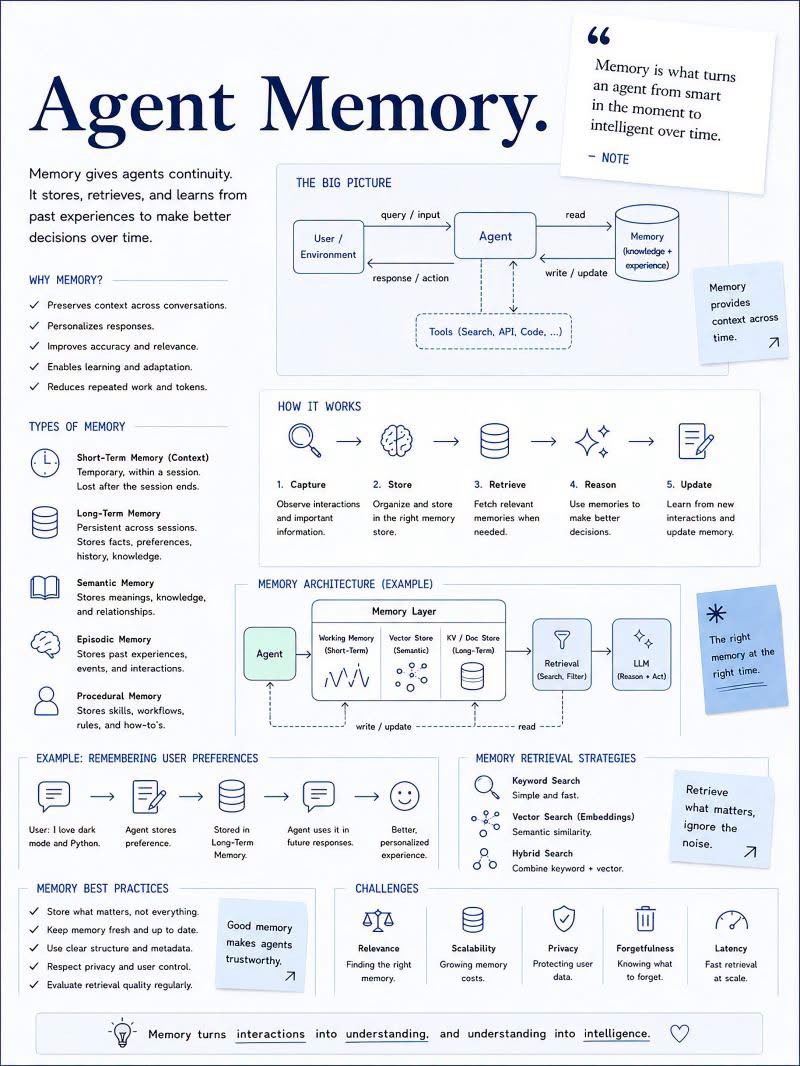
AI agent memory refers to the ability of artificial intelligence agents to store and retrieve information, enabling them to learn from experiences and improve their performance over time. An AI agent with memory can store and use various types of information, including short-term, long-term, semantic, episodic, and procedural memory.
Types of AI Agent Memory
There are several types of memory that an AI agent can have, each with its own unique characteristics and functions. These include:
- Short-term memory: remembers context within the current session, but loses it when the session ends.
- Long-term memory: stores information across multiple sessions, such as preferences, work history, and familiar requests.
- Semantic memory: remembers knowledge, meanings, and relationships between concepts.
- Episodic memory: remembers events or interactions that have occurred.
- Procedural memory: remembers how to perform tasks, workflows, rules, and skills.
The Memory Loop
The memory loop typically consists of five steps: capture, store, retrieve, reason, and update. Each interaction with the AI agent helps it understand the user better for the next interaction.
Benefits of AI Agent Memory
The ability of an AI agent to store and retrieve information is crucial for its development from a simple chatbot that responds to individual queries into a system that can learn from experiences and work more efficiently.
Practical Applications of AI Agent Memory
The use of AI agent memory has various practical applications, including:
- Personalized user experiences
- Improved task automation
- Enhanced decision-making
- Increased efficiency
How AI Agent Memory Types Works
AI Agent Memory Types becomes clearer when readers can connect the high-level idea to the underlying workflow. A strong explanation should show the path from input data to useful output, including how information is represented, processed, and evaluated.
For technical readers, the most useful details are the steps that influence quality: data preparation, model architecture, training signals, inference behavior, and feedback loops. Explaining those steps gives the article more depth without forcing beginners into unnecessary jargon.
Key Components to Understand
Most modern AI systems combine several layers: data sources, model architecture, training infrastructure, evaluation methods, and deployment controls. Each layer affects accuracy, latency, cost, and reliability in production.
Readers should also understand the role of prompts, context windows, retrieval systems, monitoring, and human review. These components often decide whether a system is merely impressive in a demo or dependable enough for real workflows.
Limitations and Risks
No technical concept should be presented as magic. The article should explain where the approach can fail, including inaccurate outputs, outdated context, biased data, privacy concerns, unclear evaluation, and operational cost.
These limitations do not make the technology unusable, but they do shape how teams should apply it. Good implementation usually includes validation, logging, security review, and a plan for human oversight when decisions matter.
Practical Takeaways
- Start with the core concept before moving into architecture or implementation.
- Connect each technical detail to a practical use case or decision.
- Call out limitations clearly so readers know how to apply the idea responsibly.
How to Use This Resource Effectively
A useful article about AI Agent Memory Types should help readers connect the simple explanation, the technical mechanism, and the practical decision they may need to make next. That means the content should not stop at definitions; it should show why the topic matters, where it fits, and how readers can evaluate it responsibly.
For beginners, the most important value is a clear mental model. They should understand the problem the technology solves, the kind of input it receives, the kind of output it produces, and the reason results can vary from one situation to another.
For technical readers, the article should point toward architecture, data quality, evaluation, and deployment tradeoffs. These details explain why two systems with similar demos can behave very differently in production, especially when the data is specialized or the workflow has strict quality requirements.
For business readers, the practical question is not whether the technology is impressive. The better question is whether it can reduce friction, improve decision quality, support a team process, or create a better user experience without adding unacceptable operational risk.
The strongest next step is to compare a short accessible resource with a deeper technical resource, then write down what each one clarifies. That approach gives readers both confidence and caution, which is usually the right balance for fast-moving technology topics.
Readers should also look for examples that show both successful and difficult cases. A balanced example set makes the article more useful because it reveals the boundary between a clean demonstration and a real operating environment.
Finally, every recommendation should connect back to a practical decision. If the article cannot help someone choose what to learn, test, adopt, avoid, or monitor next, it probably needs more context before publication.
Readers should use the linked source to compare the summary against the original implementation details, especially when architecture, tooling, or deployment steps influence the final decision.
- Define the core concept in plain language.
- Identify the main technical components.
- Map the idea to real workflows.
- Check limitations before recommending adoption.
- Use references to verify important claims.
Source Images
Conclusion
In conclusion, AI agent memory is a critical component of artificial intelligence, enabling agents to learn from experiences and improve their performance over time. By understanding the different types of AI agent memory and how they work, developers can create more efficient and effective AI systems that provide better user experiences.