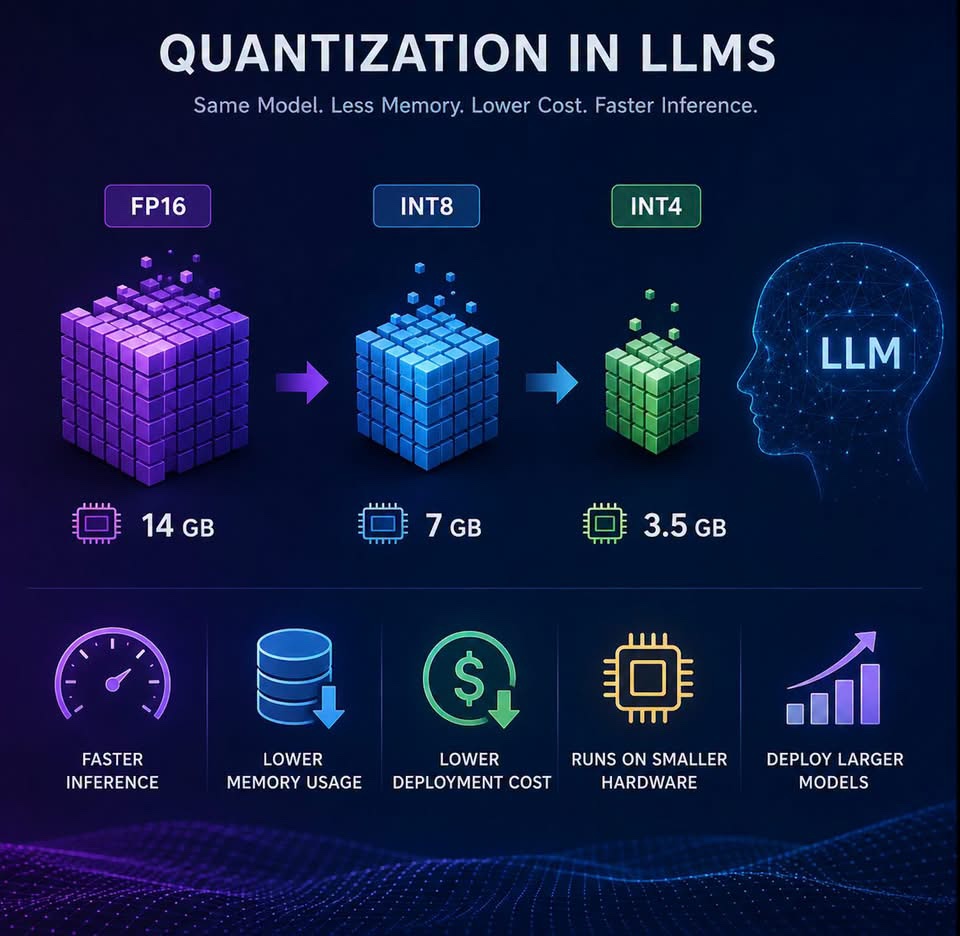
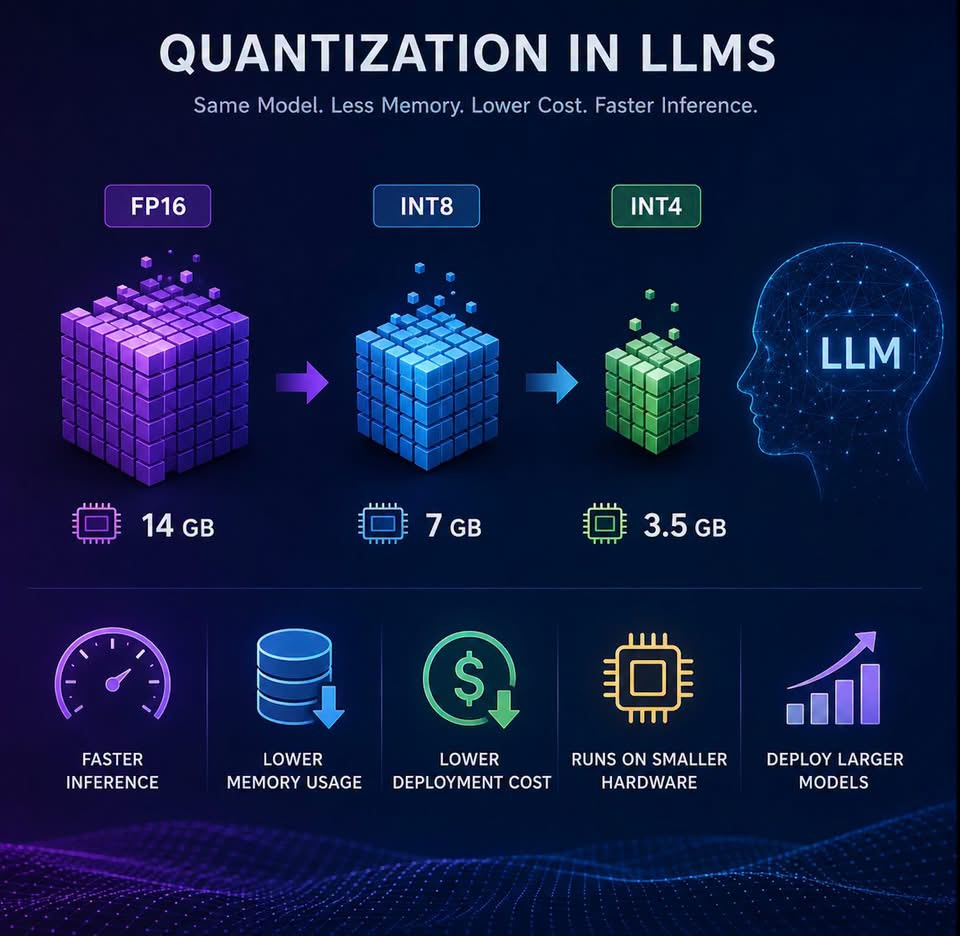
LLM量化 is a technique used to reduce the memory requirements of large language models. These models typically need a significant amount of memory to operate. For instance, a model with 7 billion parameters would require approximately 14 GB of memory using FP16, around 7 GB with INT8, and about 3.5 GB with INT4. Notably, the model's architecture remains unchanged; the system simply reduces the number of bits used to store the weights. Thanks to quantization, models can run faster, use less memory, reduce deployment costs, and even operate on smaller GPUs or personal computers. In exchange, the quality may slightly decrease in some cases. However, modern methods often help retain most of the model's performance. Essentially, quantization allows for the same model but makes it lighter, cheaper, and easier to deploy.
什么是量化?
Quantization is a process that reduces the precision of the model's weights from a higher bit representation (like 32-bit floating-point numbers) to a lower bit representation (such as 8-bit or 4-bit integers). This reduction in precision leads to a decrease in the model's memory footprint and can also speed up computations, as operations on lower-bit representations are typically faster.
LLM 量化的好处
大型语言模型中量化的好处是多方面的:
- Reduced Memory Usage: By decreasing the bit width of the model's weights, quantization significantly reduces the memory required to store the model. This is particularly beneficial for deploying models on edge devices or in environments where memory is limited.
- 提高性能:量化模型比全精度模型运行得更快。这是因为较低位表示的操作可以更快地执行,特别是在针对整数操作优化的硬件上。
- 降低部署成本:随着内存和计算需求的减少,部署和运行大型语言模型的成本也随之降低。这使得将这些模型集成到广泛的应用程序和设备中变得更加可行。
- 更广泛的部署可能性:量化可以在较小的 GPU、CPU 甚至 TPU 或边缘设备等专用硬件上部署大型语言模型,从而扩展了这些模型的潜在用例。
注意事项和限制
虽然量化具有多种优点,但也有一些注意事项:
- Potential Quality Decrease: Reducing the precision of the model's weights can lead to a loss in model accuracy. However, the extent of this decrease can vary depending on the model, the quantization method used, and the specific task the model is being applied to.
- Quantization Methods: Different quantization methods can yield varying results in terms of model performance and efficiency. Some methods may better preserve the model's accuracy than others.
实用要点
对于希望在大型语言模型中利用量化的从业者和开发人员来说,有几个关键要点值得考虑:
- Evaluate Quantization Methods: Different quantization techniques can have significantly different outcomes. It's crucial to evaluate which method works best for your specific model and use case.
- Assess Model Sensitivity: Some models may be more sensitive to quantization than others. Understanding how quantization affects your model's performance is essential for making informed decisions.
- 考虑部署环境:量化方法和位宽的选择应受到目标部署环境的影响,包括可用的计算资源和内存限制。
LLM 中的量化如何运作
当读者可以将高级想法与底层工作流程联系起来时,法学硕士的量化就会变得更加清晰。强有力的解释应该显示从输入数据到有用输出的路径,包括如何表示、处理和评估信息。
对于技术读者来说,最有用的细节是影响质量的步骤:数据准备、模型架构、训练信号、推理行为和反馈循环。解释这些步骤可以使文章更加深入,而不会迫使初学者使用不必要的术语。
需要理解的关键组成部分
大多数现代人工智能系统都结合了几个层次:数据源、模型架构、训练基础设施、评估方法和部署控制。每一层都会影响生产中的准确性、延迟、成本和可靠性。
读者还应该了解提示、上下文窗口、检索系统、监控和人工审查的作用。这些组件通常决定系统是仅在演示中令人印象深刻,还是对于实际工作流程足够可靠。
实施注意事项
当团队在法学硕士中应用量化时,他们需要的不仅仅是概念概述。他们应该决定允许哪些数据、如何审查输出、哪些性能指标很重要,以及该技术在现有工作流程中的适用位置。
实际实施还需要明确的所有权。产品团队定义用户问题,工程师管理可靠性和集成,安全团队审查数据暴露,业务利益相关者决定可接受的自动化级别。
源图像
结论
LLM 中的量化是一种强大的技术,可减少内存占用并提高大型语言模型的性能。通过了解量化的好处、注意事项和实际影响,开发人员可以在从边缘设备到云服务的各种应用中更有效地使用这些模型。无论目标是在较小的硬件上部署模型、降低成本,还是只是为了使这些强大的工具更易于使用,量化都是需要考虑的重要策略。