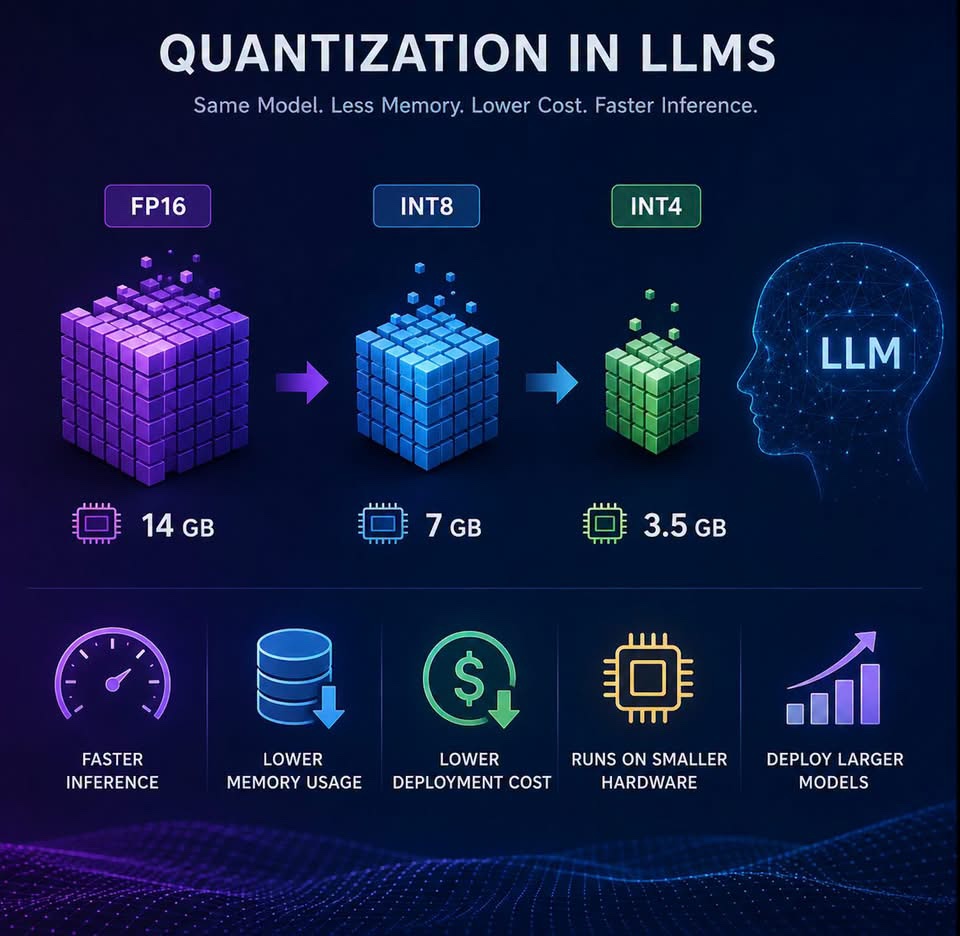
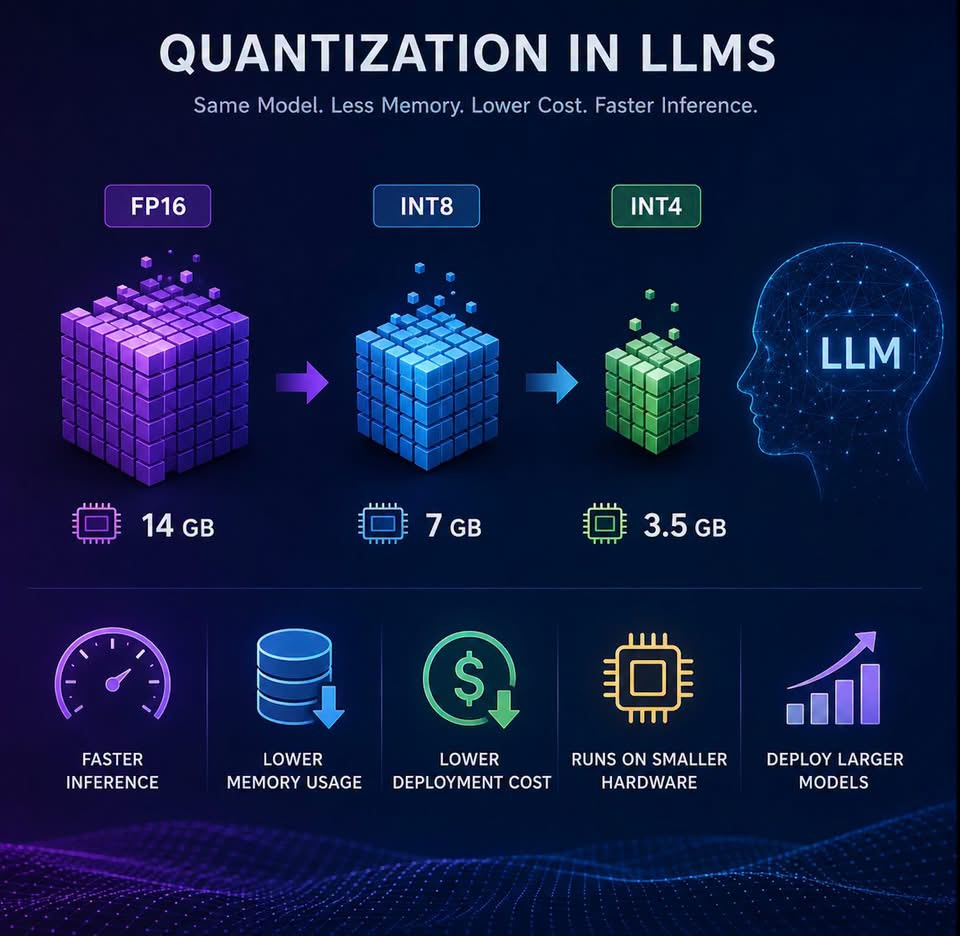
Lượng tử hóa trong LLM is a technique used to reduce the memory requirements of large language models. These models typically need a significant amount of memory to operate. For instance, a model with 7 billion parameters would require approximately 14 GB of memory using FP16, around 7 GB with INT8, and about 3.5 GB with INT4. Notably, the model's architecture remains unchanged; the system simply reduces the number of bits used to store the weights. Thanks to quantization, models can run faster, use less memory, reduce deployment costs, and even operate on smaller GPUs or personal computers. In exchange, the quality may slightly decrease in some cases. However, modern methods often help retain most of the model's performance. Essentially, quantization allows for the same model but makes it lighter, cheaper, and easier to deploy.
Lượng tử hóa là gì?
Quantization is a process that reduces the precision of the model's weights from a higher bit representation (like 32-bit floating-point numbers) to a lower bit representation (such as 8-bit or 4-bit integers). This reduction in precision leads to a decrease in the model's memory footprint and can also speed up computations, as operations on lower-bit representations are typically faster.
Lợi ích của lượng tử hóa trong LLM
Lợi ích của lượng tử hóa trong các mô hình ngôn ngữ lớn là rất nhiều mặt:
- Reduced Memory Usage: By decreasing the bit width of the model's weights, quantization significantly reduces the memory required to store the model. This is particularly beneficial for deploying models on edge devices or in environments where memory is limited.
- Improved Performance: Quantized models can run faster than their full-precision counterparts. This is because operations on lower-bit representations can be executed more quickly, especially on hardware optimized for integer operations.
- Lower Deployment Costs: With reduced memory and computational requirements, the cost of deploying and running large language models decreases. This makes it more feasible to integrate these models into a wide range of applications and devices.
- Broader Deployment Possibilities: Quantization enables the deployment of large language models on smaller GPUs, CPUs, or even specialized hardware like TPUs or edge devices, expanding the potential use cases for these models.
Cân nhắc và hạn chế
Mặc dù lượng tử hóa mang lại một số lợi ích nhưng nó cũng đi kèm với một số điều cần cân nhắc:
- Potential Quality Decrease: Reducing the precision of the model's weights can lead to a loss in model accuracy. However, the extent of this decrease can vary depending on the model, the quantization method used, and the specific task the model is being applied to.
- Quantization Methods: Different quantization methods can yield varying results in terms of model performance and efficiency. Some methods may better preserve the model's accuracy than others.
Bài học thực tế
Đối với những người thực hành và nhà phát triển đang tìm cách tận dụng lượng tử hóa trong các mô hình ngôn ngữ lớn của họ, một số điểm chính cần xem xét:
- Evaluate Quantization Methods: Different quantization techniques can have significantly different outcomes. It's crucial to evaluate which method works best for your specific model and use case.
- Assess Model Sensitivity: Some models may be more sensitive to quantization than others. Understanding how quantization affects your model's performance is essential for making informed decisions.
- Consider the Deployment Environment: The choice of quantization method and the bit width should be influenced by the target deployment environment, including the available computational resources and memory constraints.
Cách lượng tử hóa trong LLM hoạt động
Lượng tử hóa trong LLM trở nên rõ ràng hơn khi người đọc có thể kết nối ý tưởng cấp cao với quy trình làm việc cơ bản. Một lời giải thích rõ ràng sẽ chỉ ra đường dẫn từ dữ liệu đầu vào đến đầu ra hữu ích, bao gồm cả cách trình bày, xử lý và đánh giá thông tin.
Đối với người đọc kỹ thuật, chi tiết hữu ích nhất là các bước ảnh hưởng đến chất lượng: chuẩn bị dữ liệu, kiến trúc mô hình, tín hiệu huấn luyện, hành vi suy luận và vòng phản hồi. Việc giải thích các bước đó giúp bài viết có chiều sâu hơn mà không buộc người mới bắt đầu phải sử dụng những thuật ngữ không cần thiết.
Các thành phần chính cần hiểu
Hầu hết các hệ thống AI hiện đại đều kết hợp nhiều lớp: nguồn dữ liệu, kiến trúc mô hình, cơ sở hạ tầng đào tạo, phương pháp đánh giá và kiểm soát triển khai. Mỗi lớp ảnh hưởng đến độ chính xác, độ trễ, chi phí và độ tin cậy trong sản xuất.
Người đọc cũng nên hiểu vai trò của lời nhắc, cửa sổ ngữ cảnh, hệ thống truy xuất, giám sát và đánh giá của con người. Các thành phần này thường quyết định liệu hệ thống chỉ ấn tượng trong bản demo hay đủ tin cậy cho quy trình làm việc thực tế.
Cân nhắc thực hiện
When teams apply Lượng tử hóa trong LLM, they need more than a conceptual overview. They should decide what data is allowed, how outputs will be reviewed, what performance metrics matter, and where the technology fits inside an existing workflow.
A practical implementation also needs clear ownership. Product teams define the user problem, engineers manage reliability and integration, security teams review data exposure, and business stakeholders decide what level of automation is acceptable.
Nguồn hình ảnh
Phần kết luận
Lượng tử hóa trong LLM is a powerful technique for reducing the memory footprint and improving the performance of large language models. By understanding the benefits, considerations, and practical implications of quantization, developers can make more effective use of these models in a wide range of applications, from edge devices to cloud services. Whether the goal is to deploy models on smaller hardware, reduce costs, or simply to make these powerful tools more accessible, quantization is an essential strategy to consider.